


Catering, Catering Delivery or Buffet: What Is the Difference?

- Catering is the complete solution including service, equipment and planning
- Pure catering delivery suits simple office formats with little service required
- A buffet is a presentation format and can be part of both models
- 8-point checklist for comparing catering quotes
Anyone planning a business event quickly comes across three terms that are often mixed up: catering, catering delivery and buffet. For company parties, conferences, trade fairs, workshops or client events, the distinction matters, because it shapes your budget, staffing, schedule, equipment and the impression you make on your guests. Here you will learn what each term means, which option suits which occasion and how to compare catering quotes realistically.
What is the difference between catering, catering delivery and a buffet?
In a business context, catering usually means a full service covering food, drinks and logistics, often complemented by service staff, equipment and event planning. Pure catering delivery is leaner: prepared food is delivered, with little or no on-site service. That works best for straightforward office formats. A buffet, on the other hand, is not a service in its own right but a way of presenting food: dishes are set up and your guests help themselves, sometimes supported by staff.
So the key difference is not just the food, but the scope of service. When comparing, ask yourself: who plans the schedule? Who sets up and clears away? Who provides crockery, glassware, furniture or kitchen equipment? Who makes sure the food is ready at the right time and in the right quality? This is exactly where simple delivery offers and full event catering part ways.
Catering: the complete solution for demanding business events
Catering is the broadest category and becomes especially relevant when several moving parts need to fit together. At a conference with a welcome reception, coffee breaks, lunch, networking and an evening programme, simply delivering food is not enough. You need timing, quantity planning, staff, replenishment, waste disposal, drinks service and a presentation that suits the occasion.
Typical building blocks of business catering include:
- Food and drinks: from business lunch and finger food to a multi-course menu.
- Service staff: for reception, food service, table service, drinks service or a flying buffet.
- Equipment: crockery, cutlery, glassware, buffet modules, coffee machines, cooling or mobile cooking equipment.
- Coordination: alignment with the venue, event agency, technical team or office and facility managers.
- Dietary requirements: vegetarian, vegan, allergen-aware or culturally appropriate options.
- Presentation: food stations, live cooking, corporate branding at the buffet or themed set-ups.
The advantage: you get a solution built around accountability, reliability and a professional guest experience. That matters most when clients, business partners, investors, executives or large teams are invited. A smooth event does not happen by chance, but through clear roles, careful planning and a caterer who takes on more than just cooking.
Catering delivery: lean, practical and clearly limited
Pure catering delivery can be exactly right for everyday business when the occasion is manageable and little service is needed. Prepared dishes such as platters, warm components, salads, snacks or simple desserts are delivered. Setting up, serving, drinks and clearing away are often left to you or only supported to a small extent.
Typical occasions include internal team meetings, training days, small project wrap-ups, department get-togethers or simple office lunches. What matters is clear expectations: service staff, crockery, furniture, signage, allergen labelling, timing for several programme points or on-site coordination are not automatically included.
That is why a sober look at quotes pays off. An inexpensive delivery can be ideal for simple formats, but becomes risky when the event is representative, time-critical or logistically demanding. Then extra internal effort arises: someone has to watch delivery times, place the food, manage leftovers, inform guests and tidy up afterwards. That working time belongs in the overall assessment.
Buffet: a presentation format, not a service category
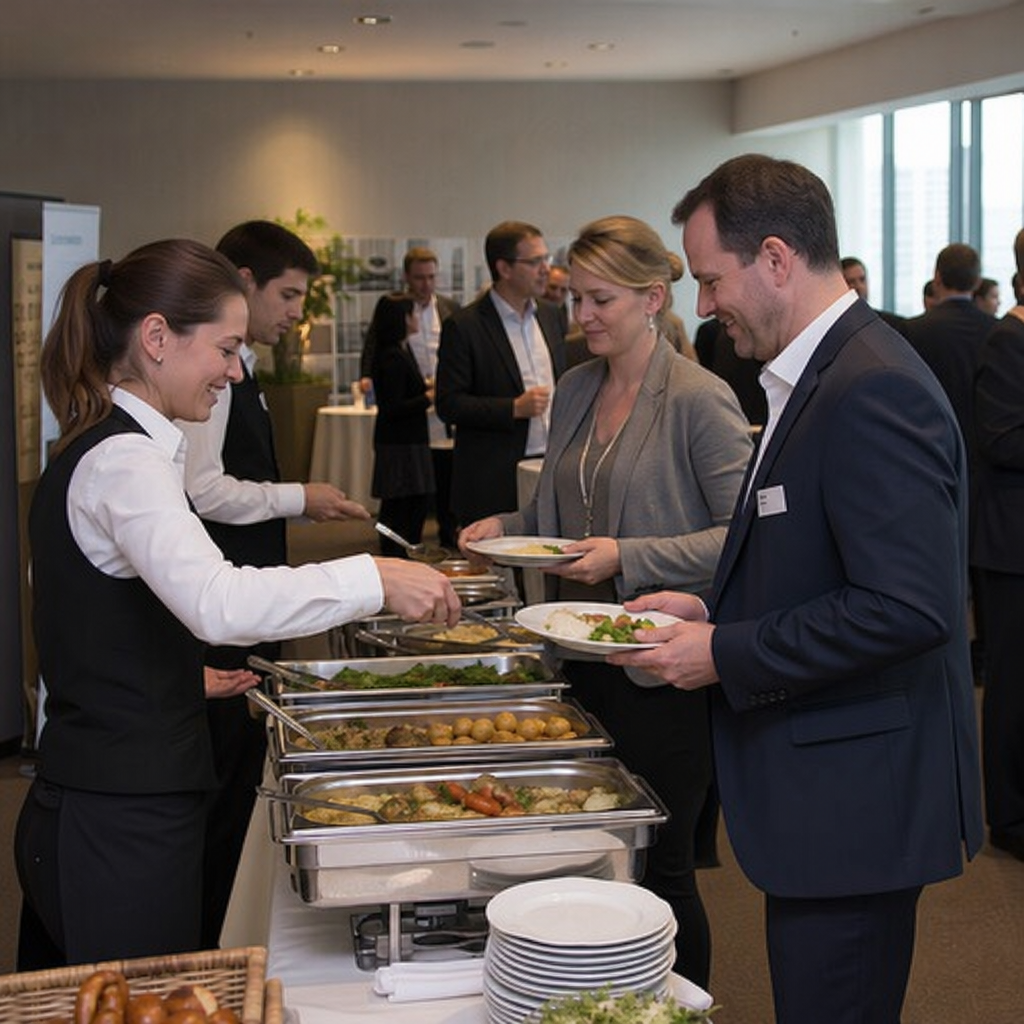
A buffet answers the question of how food is offered, not who delivers the overall service. It can be part of full-service catering or part of a simple delivery. Execution ranges from a basic set-up in a meeting room to a designed food area with signage, service staff and well-planned guest flow.
Buffets are popular in business settings because they are flexible. Guests choose for themselves, portion sizes can be adjusted individually and different dietary needs can be visibly separated. At the same time, a buffet needs space, good guest flow and clear information. With many guests, queues form quickly if the number of stations, serving points or staff does not match the group size.
Think about the impression, too: a buffet is sociable, lively and efficient, but feels less formal than a seated menu. For trade fair parties, networking evenings or internal annual events, that works perfectly. For a board dinner, an awards ceremony or a tightly scheduled client meeting, a seated menu or flying buffet is often the better choice.
Which option suits which business occasion?
The right choice depends on your event goal, guest count, level of formality, venue, schedule and internal resources. The more accountability, coordination and presentation quality required, the more a professional catering service pays off. The simpler the occasion and the more you can handle yourself, the more likely delivery is enough. A buffet is a possible presentation format in both models.
A quick orientation:
- Conference with several breaks: full-service catering, because timing, replenishment and guest flow need active management.
- Client event with brand impact: catering with designed food stations, because presentation and service signal professionalism.
- Internal team lunch at the office: catering delivery or lunch catering, because the schedule is simple.
- Networking reception: flying buffet or finger food catering, so guests stay mobile and conversations flow.
- Trade fair stand with changing visitors: a modular catering concept with small portions, drinks service and quick availability.
- Executive meeting on a tight schedule: seated menu or attended lunch for reliability and a calm flow.
- Virtual or hybrid team event: catering boxes, so participants in different locations share a common experience.
This overview does not replace a quote, but it shows which questions to clarify before you request one. For larger events, do not just ask for "food for X people", but for a solid concept: when do guests arrive, how long are the breaks, where do people move and what atmosphere should the event have?
Catering types and presentation formats at a glance
For business events, what counts is less how original something sounds and more which format supports the purpose of your event. A format for networking and movement needs different food than a focused seminar or a formal reception.
Buffet, finger food and flying buffet
A classic buffet works when guests expect choice and flexibility. It suits medium to large groups, provided space, stations and timing are planned professionally. Finger food is especially practical for receptions, trade fair stands and breaks, because it needs no seating plan and makes conversation easier. A flying buffet combines service and mobility: staff bring small dishes directly to guests, which reduces waiting times and supports networking.
Seated menu and attended food stations
A seated menu suits more formal occasions where schedule, dramaturgy and seating play a bigger role. It feels calmer and more predictable, but requires careful collection of intolerances and menu preferences. Food stations or live cooking elements create activity and an experience, ideal for an open, modern atmosphere within a professional setting.
Mobile, hybrid and flexible concepts
Current catering trends include mobile solutions, pop-up stations, office lunch concepts, more sustainable menu planning and catering boxes for hybrid teams. They respond to changing ways of working: teams are distributed, event spaces vary and time slots are getting shorter. But do not book trends for their own sake. A format should simplify the schedule, improve participation or strengthen the brand experience.
How to compare catering quotes properly
A clean comparison does not start with the price per person, but with the expected level of service. Two quotes can look similar at first glance and still include very different services. So check each component individually and clarify open points in writing.
- Define the event goal: is it about feeding people, representation, networking, employee retention or client experience?
- Describe the guest profile: number of guests, time slot, roles of participants and any international requirements.
- Check the venue: is there a kitchen, power, water, delivery access, lifts, storage space and venue rules?
- Set the service level: clearly separate delivery, set-up, serving, table service, drinks service, clearing and cleaning.
- Ask about equipment: do not assume crockery, glassware, cutlery, bar tables, buffet modules, cooling or signage are included.
- Plan for dietary needs: agree on allergens, vegetarian and vegan options and labelling early.
- Make timing concrete: plan delivery, set-up, service times, breaks, speeches, clearing and buffers realistically.
- Clarify responsibilities: who decides on site, who solves problems and who is the contact for venue and technology?
These points protect you from misunderstandings and hidden extra effort. At events with external guests in particular, a small logistical mistake is noticed quickly: cold coffee during the break, missing glasses at the reception or long queues at the buffet spoil the overall impression. Good caterers think these situations through in advance.
Platform or booking directly with a caterer?
Many companies wonder whether to book directly with a caterer or through a platform. With heycater! you do not have to choose: for office lunches, meetings and company parties, Meetings & Catering gets you no-obligation quotes from vetted caterers in our network of more than 700 partners, including personal advice. For complex events with venue, programme and on-site management, hey! Events takes care of the entire planning.
That way you get the choice and comparability of a platform and, at the same time, a dedicated contact who clarifies schedules, questions and special requests with the caterer.
Conclusion: the right term saves effort and improves your event
Catering, catering delivery and buffet are not interchangeable terms. Catering stands for comprehensive planning and execution, delivery for lean provisioning and a buffet for a specific presentation format. Knowing these differences helps you read quotes better, plan internal resources more realistically and choose the right format for your occasion.
For simple office formats, reliable delivery is often enough. For conferences, client events, trade fairs or demanding corporate events, catering with a well-thought-out service concept pays off. In the end, what matters is not the term on the quote, but whether service, accountability and schedule fit your event.
Discover catering



Ready for stress-free business catering?